Tuesday, January 17, 2006

Visas


Jen rounded up the necessary documents needed for VISAs from Ajay and Jeremiah, and I met up with her last week to pick them up from her. One benefit of living in Washington DC is the convenience of hopping on the metro to deliver the documents in person. Less worry about having all of our passports in limbo in the U.S. mail. The Tanzanian embassy is located at 2139 R Street, a few blocks west of the Dupont Circle Metro (photos). It takes 5 business days to process, so Jen or I should be able to pick them up next Monday.

A tourist visa application can be obtained online from the Tanzanian Embassy website. In addition you need:
--a passport (must be > 6 months before expiration)
--$50
--2x2 inch passport photo
--copy of travel itinerary and/or plane ticket
--evidence of being able to financially support yourself for the duration of stay. This could be a bank statement or letter from bank stating you are not a deadbeat
--self addressed envelope with correct postage for return of passport/visa if it needs to be mailed

Labels: ,

Thursday, January 12, 2006

Gettin In Shape, Part Deux

Getting in shape is certainly one thing that someone wishing to climb Kilimanjaro has control over. Nonetheless, stories abound about how some of the most fit trekkers fail to summit, while some of the least likely, seemly out of shape, hikers bound to the top like mountain goats. Ultimately how one responds to altitude seems to be the big unknown….

As always, I had much more ambitious plans for getting in shape than what I have actually done, but at least I’ve been consistent. I’ve averaged 4-7 hours of aerobic exercise per week, trying to get in at least one longer workout on the weekend with 1 hour workouts scattered throughout the week (plus some occasionally weight lifting thrown in). Most of it has been biking (either on the road or spinning), occasional running (limited due to an injury back in October), and taking Ajay’s lead, some workouts oriented towards getting use to hiking with pack.

I’ve done a lot of backpacking in the past; but most of these trips are relatively short, so putting up with sore hips, back, and blisters is usually pretty tolerable if you know that you’ll be kicking back in an easy chair with your feet propped up in another day or two. However, I definitely want to try to adapt to this as much as possible before Kilimanjaro. I started by climbing a 15 story stairwell in Building 10 at the NIH, carrying a 30 lb. pack, taking the elevators down, and doing it again. And again. And again. I managed to do 525 flights in about 3.5 hours one weekend (>5200 vertical feet) but would probably go insane if I try that again. Since then, I’ve joined a gym and have taken my side-show to the treadmill, and I’m glad I did. One hour of sisyphian climbing on a treadmill with incline and voila…blisters. I was somewhat surprised by this because I have been using my boots for many years and have never really had a big problem with blisters with this pair. However, usually I don’t hike with as thick socks as I have been using to train with (as these are what I will be using on Kilimanjaro). Better now than later. Although climbing an actual stairwell with pack was more of a quad buster (especially taking 2 steps at a time), it’s a lot easier to get the heart rate up on a treadmill. So far, I’ve done a lot of the workout with my HR 170-180 (85-90% max) as this is probably what it’s going to be doing at altitude. And judging by the blisters, the treadmill simulates actual hiking to a much better extent than stair climbing.

Still have a couple more weeks…

Labels: ,

Sunday, January 08, 2006

Helpful advice provided by Roy's Safari

Some of the things you should bring are: cool-light clothing for the day and something warm for the evenings. (You will be spending a night in Ngorongoro where temperatures at night sometimes drop to about 7 degrees Celsius). In addition, it is advisable to carry insect repellent, sunglasses, suntan lotion, some form of antihistamine cream and other personal toiletry requirements.

Of course, you will want to capture much of Tanzania's wildlife, so don't forget a camera, batteries and film. A medium range telephoto lens will be found useful as will a pair of binoculars. In case you're bringing any electrical equipment, the electricity is 220v.

Loss of luggages: Sometimes owing to short connections times or delays caused from your origin flight-bagages get delayed and we run into problems. Now I would suggest you do the following:

a). Carry a hand luggage with your essentials such as toleitries, medicines, camera and a set of clothes change.

b). If your baggage is lost-please clearly mention on Baggage Irregularity form-your duration of stay in Tanzania and contact details (these are of roy safaris for the period you will be with us).

Please bring a copy of your medical travelling insurance.

Balance due
The balance due can be paid on arrival in Arusha in form of US$ cash. (New US$ bills, the older notes are not accepted)/travellers cheques.

ONLY THE FOLLOWING US$ Travellers cheques are accepted:-
• American Express,
• VISA
• Mastercard.

Note:
credit cards cannot be used widely in Tanzania and in places where accepted, expect surcharges of between 11.8 - 20%.
For all payment done by Travellers cheques will be a banking surchage as follows:
US$ 1- 4000 : US$ 10 total
US$ 4000 and above : 0.25%.

EMERGENCY CONTACT INFORMATION
In case of an emergency, you can reach us on the following numbers:
If dialing from Outside East Africa: +255 27 250 7940/+255 27 250 8010/+255 27 250 7057/+255 27 250 2115
Cellphone ( 24hrs) +255 744 375 440
From Nairobi-Kenya: 007 744 375 440
From within Tanzania: 0744 375 440

Labels: ,

Useful Kilimanjaro and Safari Links


SUPPORTING CANCER RESEARCH
Jimmy Fund
Dana-Farber Cancer Institute

PRE-TRIP PLANNING

Tanzanian embassy in the U.S. Info on passports, VISA, and general tourism. Hasn’t recently been updated (since 2004)

U.S. State Dept: Background notes on Tanzania and Consular Information Sheet

CIA

Gear checklists: Alpine Ascents or Climbing Kilimanjaro

Getting Started: Site 1 or Site 2


MEDICAL ISSUES

Centers for Disease Control (CDC): First stop for learning about bugs and drugs

The World Health Organization (WHO)
: Has a good downloadable PDF outlining all the bugs that should keep you up at night worrying how to avoid. See their travelers health section, followed by the PDF titled “Vaccine-preventable diseases, vaccines and vaccination”

High Altitude Medicine.

KILIMANJARO CLIMB

Zara Travel International
. This is the company we will use for our Kilimanjaro climb. However, most of the pre-trip planning was done through contact with EWP, a British travel agency that manages the ZARA website.


SAFARI:
Roy’s Safari. One of the key reasons Ajay picked this company is the reputed quality of vehicles (Toyota Landcruisers or Landrovers). Breakdown of vehicles in the rugged plains of the Serengeti is not an uncommon thing, and automobile accident's are the number one cause of bad stuff for tourists.

We will stay at two different places during our safari:

Sopa Lodges. We will stay at the lodge located near the Ngorongoro Crater for one night on February 8, 2006.

Serengeti Serena Lodge. We will stay for two nights at this lodge on February 9 and 10th 2006.

OTHER BLOGS:
John's African Safari
Climb-Kili
kili2006 (continuation of Climb-Kili)
2002 Kilimanjaro Climb
marisa-u.blogspot.com

Labels: ,

Tuesday, January 03, 2006

Our Itinerary


Maps are from (www.encountertanzania.com)

The organization of this trip was Ajay's baby. He put a lot of effort into researching and planning. Maybe he'll give his two cents if he gets a chance. Based on his work, our itinerary:

January 30th, 2006. Arrive JRO airport in the evening. Meet Zara Tours and
transfer to the Springlands hotel near Moshi for B&B accommodation.
January 31st. Spare day. Overnight Springlands hotel.

February 1st (leg 1). KILMANJARO, MACHAME ROUTE (a more detailed description of this hike can be found here). After breakfast drive to Machame village (1800m). Walk to Machame hut (3000m), a 1200m gain in elevation. 6 hours walking for 10km distance. This is a walk through the cloud forest.

February 2nd (leg 2). To Shira hut (3800m, 5 hours). 800m elevation gain. Only 7km total distance but steep. The summit comes into view during this leg as you climb above the forest. Two distinctive flora of the mountain first make their appearance: the squat, dry looking Senencia tree with a leafy crown on top, and the cabbage like, phallic Lobelias.

February 3rd (leg 3). To Barranco hut (3940m, 4 hours). Despite a 10km hike, up to a peak altitude of 4500m, only 150m gain in TOTAL elevation. Lava Towers appears during the second part of this hike, as you decend to Barranco hut.

February 4th (leg 4). To the Karanga Valley (4000m, 3 hours). Glaciers come into view. Landscape is barren. Leg 4 and 5 can sometimes be combined, but doing them on separate days allows an extra day of acclimitazation. Last chance to fill up on water.

February 5th (leg 5). Climb out of the Karanga valley to Barafu hut (4600m, 3 hours). Barafu means "ice" in Swahili, and the camp is probably called this due to its proximity to the Rebmann glacier.

February 6th (leg 6). Very early start for the summit (5892m; a 1300m gain in elevation). 6+ hours on switchbacks of loose scree to obtain the rim (Stella's point). However, it's an extra hour to Uhuruv Peak. Descend to Barafu hut for a rest and lunch (this is a hour and a half hike from Stella's point), then walk to camp at Mweka hut (3100m, and additionanl 2.5 hours hike).

February 7th (leg 7). Final descent to Mweka Park gate (1500m) and transfer to Springlands for B&B

February 8th. 8 am. Meet Roy's Safari in Moshi and drive to Office in Arusha. Afternoon Tour of Crater, followed by dinner and overnight in Ngorogoro Sopa Lodge

February 9th. Morning tour of the Ngorongoro Crater. Game drive en route to Serengeti National Park in the afternoon. Overnight in Serena Serengeti Lodge.

February 10th. Full day of game viewing in Serengeti National Park. Overnight in Serena Serengeti Lodge.

February 11th. Game viewing en route to Seronera airstrip for 1045am flight to JRO airport. Leave Tanzania in evening.

February 12th. Arrive back at the U.S.

Labels: , ,

Bugs and drugs (vaccines and stuff)


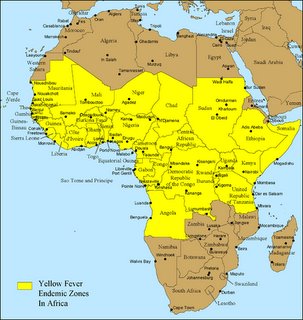
Map: Yellow Fever Belt, from CDC website

The first website that should be visited is the Travel section from the CDC (Center for Disease Control). The World Health Organization also has a good downloadable PDF outlining all the bugs that should keep you up at night worrying how to avoid. See their travelers health section, followed by the PDF titled “Vaccine-preventable diseases, vaccines and vaccination”

HIGHER PRIORITY
Although it seems as if there are an innumerable number of infectious agents that one has to be concerned about in a Tanzanian outdoor adventure, some things need to be considered higher priority based on chance of exposure, severity of illness, as well as what can be done to prevent/treat the infections. In my opinion, the main bugs we need to be concerned about are MALARIA AND GASTROINTESTINAL (foodborne, fecal-oral) illnesses that include: travelers diarrhea (EColi), cholera, Hepatitis A, and Typhoid Fever. In the U.S., there are no vaccines for travelers diarrhea or cholera (effective vaccines are available for cholera in certain countries), and not all cases of travelers diarrhea and cholera need antibiotic treatment, although this may be necessary in severe cases. Two vaccines that I think are essential include HEPATITIS A (2 shots, six months apart) and TYPHOID (the live oral form is good for 5 years, while the intramuscual injected version is good for two years). Another key vaccine includes TETANUS/DIPHTHERIA (Td), and should be administered every ten years.

There is no malaria vaccine, but malaria prophylaxis is effective in preventing infection if taken correctly. Malaria prophylaxis needs to be started at least a week before, for mefloquine, or a day before travel in the case of malarone(atovaquone/proguanil). Although doxycycline can also be used for malaria prophylaxis, it’s probably not a good choice since it can increase sun sensitivity… not a good thing standing exposed on top of Kilimanaro. Thus, the choice between mefloquine versus malarone is an individual decision. Mefloquine is cheaper, and is more convenient in that it is taken once weekly. However, neuro-psychological side effects are not uncommon, such as insomnia, bad dreams, and in worse cases, psychosis. The only documented mefloquine resistance is in the Thailand forests. Malarone has minimal side effects, but is more expensive (may be an issue since some insurance policies won’t cover this cost) and has to be taken daily.

LOWER PRIORITY
Again, lower priority doesn't mean less important, but overall chances are less (for our specific group) in encountering them. Booster shots for MEASLES and POLIO are recommended, but on a standard Tanzania safari and Kilimanjaro trek, it is unlikely that we will have exposure to these agents. The same goes for the MENINGIOCOCCAL vaccine (NEISSERIA MENINGITIDIS). Both polio and N. meningitidis can be found in western and central Africa, but in Tanzania, these bugs don’t appear to be a problem currently. HEPATITIS B vaccine is something to consider, but unless you are unfortunate to receive a contaminated blood transfusion, frequent some local bordello, or are into sharing needles for injectable recreational drugs, this is unlikely to be a problem.

For the YELLOW FEVER VACCINE, according to the CDC website as well as the WHO recommendations, this is not a REQUIREMENT when traveling directly from the U.S. to Tanzania, even though Tanzania is in the yellow fever belt. CDC does RECOMMEND the vaccine, however. Although there are a few exceptions, most countries located in the yellow fever belt require yellow fever vaccinations only if traveling FROM another country in the yellow fever zone TO their own country. In other words, they want to try to keep yellow fever from being imported into their country... they personally don't care if you catch it. However, the U.S. State Department website adds some confusion to this, simply stating that a yellow fever vaccination is REQUIRED, not really specifying whether this means everybody, or only travelers coming from yellow fever regions. This is incorrect...we checked. Nonetheless, the need for YF vaccine will continue to be a source of confusio... its probably easier to just get it. The CDC website also contains lists of clinics that are authorized to administer the Yellow Fever vaccine.

Since our safari is at the end, fortunately if we start developing undifferentiated fevers from AFRICAN TICKBITE DISEASE (Rickettsia africae) and/or AFRICAN SLEEPING SICKNESS (Trypansoma bruceii rhodesia) we will hopefully be back in the U.S. Both of these diseases are increasingly report from persons returning from safaris in Tanzania. There is no vaccine for either, and they can cause severe/fatal disease if not treated early. Avoiding ticks and tse-tse flies are the best one can do to avoid getting these bugs.

BOTTOM LINE
I ended up getting Yellow Fever vaccine, even though its not required coming from the U.S.…it’s good for 10 years and who knows I may need it in the future. We have also heard stories where people have been hassled for not having it, and in some cases made to be paid essentially a bribe to enter a country despite YF vaccine not being a requirement. Paying the $100 cost of the vaccine is probably worth avoiding the trouble by not having it. I got another typhoid vaccine (intramuscular) as well (my last one was > 3 years a go). I'm going with mefloquine for malaria prophylaxis. Although I’ve never taken this before, since I will be starting before we leave the U.S., if I end up with bad side effects, I’ll have time to switch to Malarone.

A list of meds we plan on bringing for prophylaxis, treatment, etc. It's overkill to some extent, but we have access to them, so why not. The number of tabs is based on four persons
--doxycycline (lepto, rickettsial, cholera) 100mg x 14 tabs
--levofloxacin 500mg x 14 tabs (typhoid, soft tissue, travelers diarrhea)
--pepto bismol (bismuth subsalicylate) 262mg tab 60 tabs
--ibuprofen 600 x 60
--compazine 5mg x30 tabs
--diamox (acetazolamide) 250mg three times day, 7 days x 4 persons = 84 tabs (for altitude illness)
--imodium
--DEET 10-30% Skin; clothes Permethrin
--claritin 10mg x 20
--flagyl
--dexamethasone 2mg tabs and nifedipine for treatment of HAPE and HACE, respectively

Labels: , ,